








.png)


.png)
.png)
.png)
.png)



Five Years of Heroes of Might and Magic III: The Board Game — Behind the Scenes
- DE
- ES
- FR
- PL
.png/1056_630_crop.webp?ts=1782892617&pn=cover-webp)
Since late 2020, we at Archon Studio have been working with the Might and Magic license, and it’s hard to believe that more than five years have already passed. It’s long enough to pause for a moment, look back, and reflect on the journey we’ve taken—from the very first ideas, to creating a tabletop adaptation of one of the most iconic fantasy video game series.
Our mini blog series dedicated to the lore of the Heroes of Might and Magic universe and the process of bringing it to the tabletop is coming to an end. To close it out, we’ve prepared an interview with the game’s rules designers, who share behind-the-scenes insights into the mechanics design process, the key decisions they made, and the challenges of capturing the spirit of the original game in board game form.
Beginnings
Jakub (game co-designer, project manager):
I’ve had a chance to mention both of these stories on different occasions before, but I’m happy to return to them once again.
Work on Heroes of Might and Magic III: The Board Game began on November 16, 2020. I remember that date very clearly because the day before, the Might & Magic fandom was shaken by the tragic news of the passing of Docent Picolan, the leader of the HotA Crew. Since then, both events have been inseparable in my memory. There’s a certain symbolism in that, especially in hindsight—because a few years later, the board game ended up featuring factions created by the Horn of the Abyss Crew.
Before we could actually begin development, we first had to prepare a creative proposal—a pitch deck for the license holder. Interestingly, Ubisoft itself didn’t yet have a fully defined vision for the future of the franchise at the time. Both continuing the Ashan storyline and returning to the Old Universe were on the table. Because of this, I prepared two versions of the project: one set in Ashan, and one in Enroth.
To my great joy, Enroth won out. Over time, the direction of the brand also increasingly aligned with the idea of making the board game a full tribute to Heroes of Might and Magic III, which made me even happier.Looking back after five years, I find it especially satisfying that the final version of the game is surprisingly close to what I included in that very first creative proposal. Of course, many iterations were created along the way—we tested countless systems and prototypes—but ultimately, many of the original ideas stood the test of time. A good example is the “unit upgrade tokens” that already appeared in that early presentation and eventually evolved into the stack mechanic—double-sided unit cards known from the final version of the game.
 Michał (project manager, rules development manager):
I joined the project at the turn of December 2022 and January 2023. I remember that most of the designers were on holiday at the time, and my very first task in the new job was to work on the content breakdown for the Inferno faction cards. The first draft was quickly scrapped, and it turned out that we needed to redesign most of the factions across the expansions.
We had only a few months to finish the game, and at times it was quite challenging—but looking at the number of copies sold and the ratings on BGG, I think we managed fairly well.
I remember being extremely determined to perfect the skills on the unit cards. I often analyzed cards after work, lying down and staring at the ceiling—because that’s when the best solutions tend to come.
An interesting detail from that period is that I actually joined Archon through playtesting Heroes during Pyrkon. Sometimes it feels like it was simply meant to be. Heroes of Might and Magic was almost a kind of religion in my household. My brother and I used to pick up brooms and fight each other, pretending we were Archdevils.
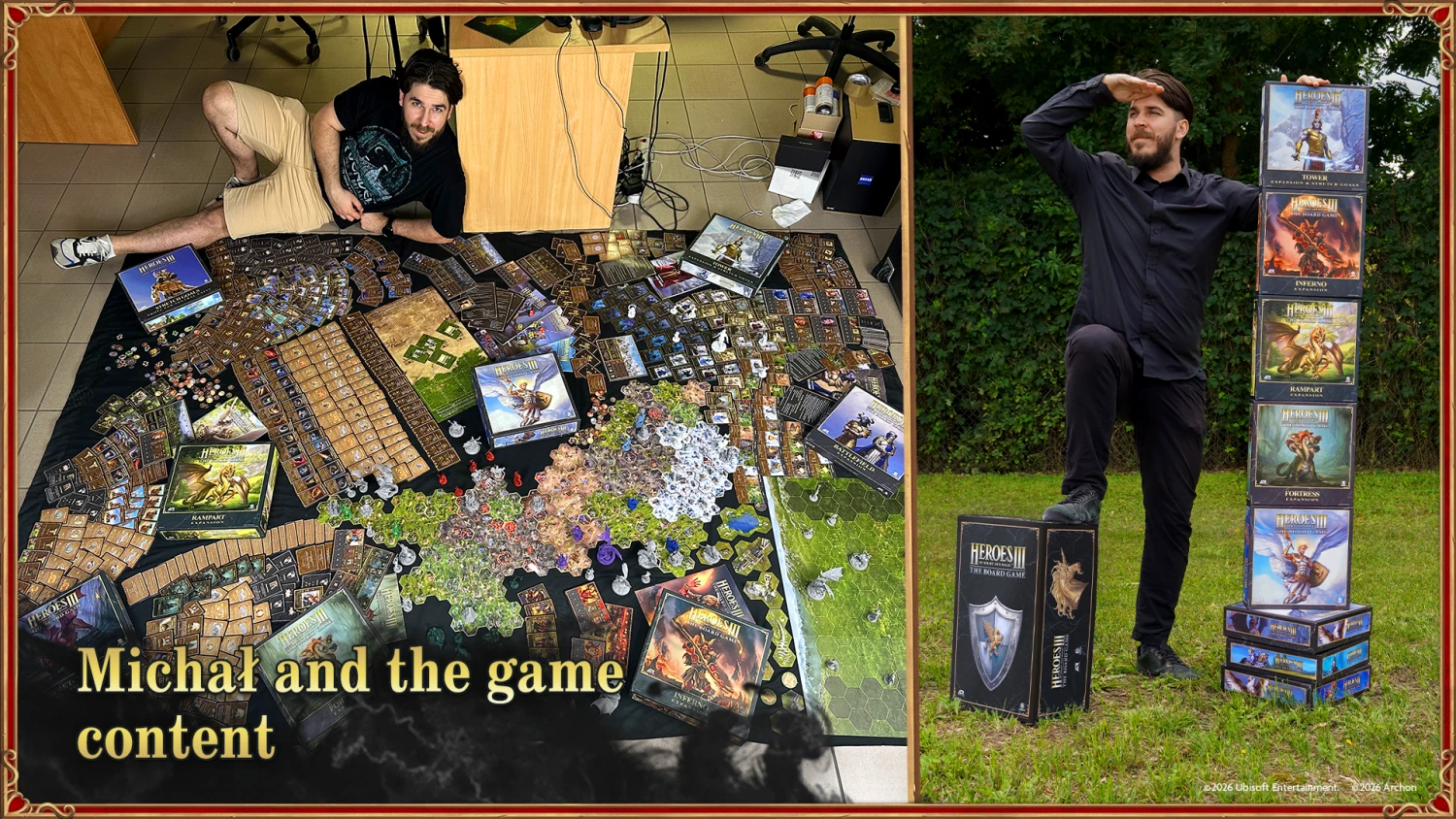
Prototypes
Kamil (game co-designer):
 The game went through a wide range of changes across virtually every aspect. The map changed the least—it was something we were almost happy with from the very first tests. Things were very different when it came to combat and armies. Here, the changes were extensive, and some of them were even revolutionary compared to the earliest sketches.
 In early versions, we tested solutions that were very close to those from the video game. Units were purchased individually, and their numbers were tracked using dice. This approach captured the spirit of the original quite well, but at the same time it introduced a lot of extra bookkeeping during gameplay. In practice, players had to perform mathematical calculations during almost every battle. For example: I have six units, each dealing two damage, then we reduce that by the opponent’s armor, check how many units were killed, and the remaining units counterattack—but only if they survived the initial strike.
At that point, a very important design question emerged, one that influenced all other elements of the project. We had to seriously consider what players actually expected, and what we could offer them in order to preserve both gameplay flow and the spirit of the original game.
The combat system went through several more iterations. Along the way, we also tested a version that used full unit counts, similar to the video game. Ultimately, however, we arrived at a solution based on double-sided unit cards, which best balanced realism, clarity, and playability.
 Speaking of combat, it’s also worth mentioning neutral units. The cards you see in the current version of the game are significantly different from their original prototypes. One early idea was to replace them with tokens. This had its advantages—tokens were convenient and didn’t take up much space on the board. However, it quickly became clear that they had very limited space for information. Adding more symbols to describe effects and abilities led to increasing clutter, and the growing list of icons and markers became difficult to manage. This issue became especially apparent given the number of different locations and neutral units that ultimately made it into the game.
That’s why we decided to switch to cards, which allowed us not only to fit all the necessary information, but also to better structure the rules and improve the overall readability of the game.
Jacek (supporting designer):
 Before the game took its current form, it went through many iterations. From the very early stages of development, we realized that translating the mechanics of the video game into a board game language wouldn’t be possible—at least not without sacrificing gameplay flow. The decisions about what to remove, what to simplify, and what to preserve faithfully were not easy.
A good example is the recruitment system. In the final version, we opted for a simple, abstract solution where new units simply join the hero’s army. However, in the early stages, we explored much more complex ideas. One concept involved automatically moving the hero to a town at the end of each round so they could recruit new units there. The maximum movement range on the map would then depend on the number of hired secondary heroes, representing the transfer of armies between heroes—much like experienced players of the computer game do. In this case, simplicity won out, but that wasn’t always the case.
Combat was by far the most difficult element to implement. Early prototypes used a faster and more abstract system, where an entire battle was resolved with a single dice roll. Individual units generated different types and quantities of damage dice, and most abilities and artifacts allowed players to manipulate the results. Ultimately, however, we concluded that for many players, combat is the most memorable part of the original game. Such a heavy simplification would not have allowed them to relive those experiences.
Alex (solo designer, writer):
Heroes in its board game form was also my first major project at the company. When I joined to help with rules and narrative design, I immediately focused on the cards. In the prototype that Kamil was testing at the time, we had several different types of cards: multiple kinds of artifacts, skills, and spells—all with their own separate slots near the hero or even separate decks. On paper, the system was genuinely interesting and gave players a lot of freedom when building their heroes.
But in practice, it was also a system where almost every card followed different rules, and the number of passive effects became difficult to track—the first playtests quickly exposed this issue. That’s why I proposed merging all those decks into a single one and drafted five core principles that became the foundation of the game’s deck-building and card usage system. They survived into the current version as the “General Card Rules.”
Then, together with Kamil and guided by those principles, we created the cards for the first three factions. The biggest challenge turned out to be the Necromancy card, which didn’t quite fit the idea of a unified deck or the established map- and combat-based effects. Even small rewrites would drastically change its balance or the category it belonged to. After several iterations, we finally managed to tame it, and it even received its own micro-rule for deck integration to preserve consistency with the original game.
Later on, I moved into reinterpreting the video game’s lore into solo campaigns, and I dedicated myself to that task in the subsequent expansions. It was a truly unique experience to shift perspective—from being a fan reading with excitement the flavor texts tied to heroes and locations, to a writer analyzing what might have been going through each character’s mind when making decisions that shaped the fate of the entire world of Enroth. It was both great fun and a valuable lesson, and a project I’m proud to have contributed to.
External Playtests, Conventions
Jakub:
There were truly a lot of tests and conventions over all those years, so I’ll limit myself to three memories that stand out the most.
I remember the very first external playtests—in Ciechocinek, organized together with my editorial colleague from Pokój Geeka, Piotr. It was there that we introduced one of the key mechanics: the turn limit in battles. Today, five years later, the story feels like a neat full circle—I’ll soon be returning to Ciechocinek again, this time to give a talk summarizing the entire project.
 I also remember Planszówki w Spodku in Katowice, where we met our proofreaders and translators, Ania and Piotr—whose Polish “fluff texts” turned out to be better than my original English versions. ;-)
 I can’t not mention one of the Gen Con editions in Indianapolis. One moment that stayed with me in particular was when a pregnant woman spent quite a long time at our booth, deeply moved while looking at the game components, thanking us for “bringing back to life” her childhood memories.
Alex:
Yes, Piotr and Ania turned out to be a wonderful extension of our Archon team. Thanks to their passion and genuinely deep knowledge of the subject, we were able to infuse the game with even more heart and atmosphere. What they did was far more than just “translation”.
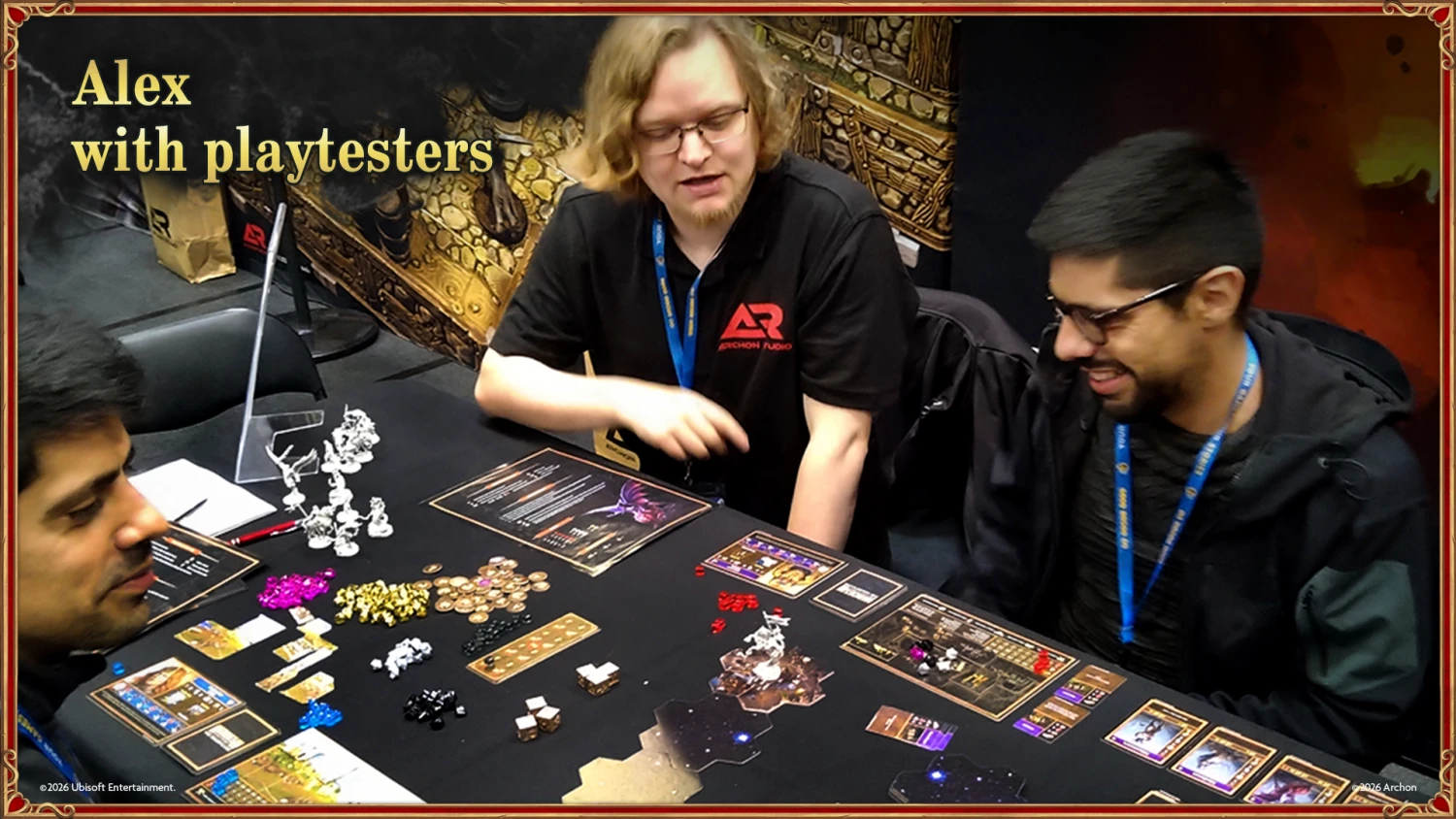
By the way, conventions and trade shows are always my favorite part of the job—nothing is more motivating than seeing people genuinely enjoy a game you helped create. And conversations with fans can often inspire the project to move in a completely different direction.
Michał:
Several months of testing delivered the expected results—and I’d really like to emphasize that the game took its final shape largely thanks to playtest groups in Poland. There was an intense four-month period when open tests were happening in every major city. We never had to worry about finding participants, because practically every fan of the IP wanted to contribute in some way.
 We received a huge amount of valuable feedback at that time and implemented changes that ultimately shaped the game into what it became. For me, that’s the true phenomenon of Heroes—a community that is incredibly creative and deeply engaged.
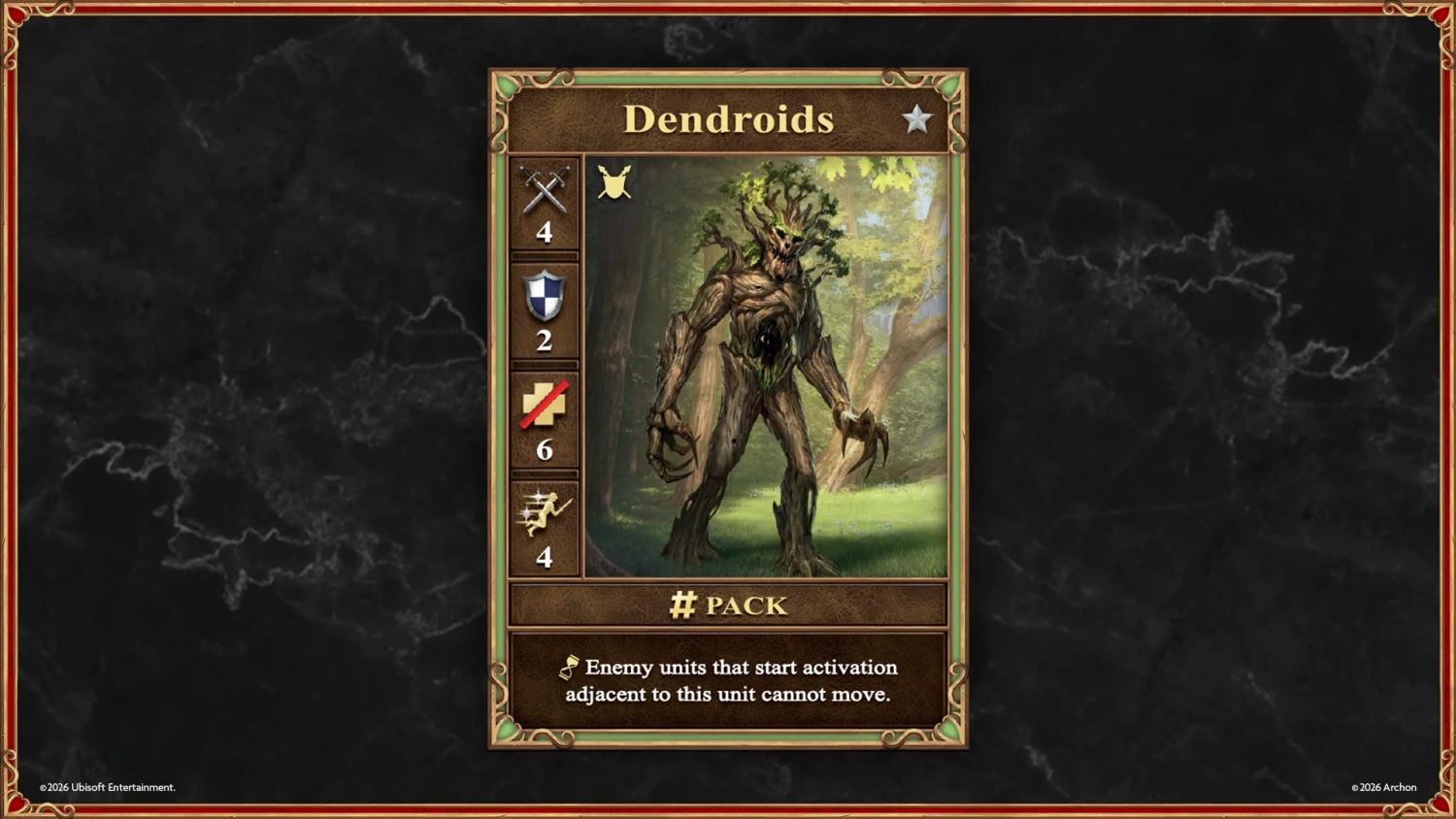
I’ll never forget how we spent two weeks working on the Dendroid from the Rampart faction skill. In my hometown, we used to just call that unit a piece of “Wood”—haha.
Robert (lead designer of the third campaign’s expansions):
Do you know what’s truly amazing when I think about it?
You walk into your local board game store one day and see that Heroes of Might and Magic III: The Board Game playtests are being organized there. Of course, you sign up… without realizing that this very decision will go on to shape the course of your life.
 I started out as a playtester. Whenever there was an opportunity, I would come in and test different versions of the game, different factions, and various mechanics. I shared all the feedback and every idea I had. After the playtests ended, I was told that if a spot ever opened up, I’d be welcome to join the Archon team. And so, after some time, I did join Archon, where I had the pleasure of helping with the second campaign of Heroes, and now I’m working on its third installment.
It truly feels incredible because I’ve seen the development of this game from the very beginning, in many different roles. I’ve experienced it as an ordinary player, as a playtester, and now as a designer. I’m genuinely happy that I could be—and still can be—a part of the story of this board game.
Trivia
Jakub:
Since we’ve already touched on flavor text, I have to admit that writing the Astrologer Cards was a huge pleasure for me. Their originality and consistency with the humor known from… New World Computing were even noticed by Neal Hallford in the recently published book “Heroes of Might and Magic: 30th Anniversary Retrospective”.
Returning to that project, I was very happy to dive into it again and also prepare the flavor text for all the Astrologer Cards in the upcoming campaign. ;-D
Alex:
The flavor text on the Astrologer Cards is one of my favorite elements of the game. We managed to pack in a huge number of references and bits of humor that players can keep discovering with every playthrough.
Michał:
One day, one of the playtesters reached out to me, saying he had noticed the “Wood Mine” texts on the prototype cards and that he actually knew their author. I had no doubts—I immediately wanted to meet this legendary team.
Thanks to this game, I had the pleasure of meeting the guys behind the Wood Mine and talking with them about their epic creative work, while also getting official permission to include their texts on the Astrologer Cards. But the best part is that this turned into a really great collaboration. We even hired some of the project’s backers full-time at Archon. We wrote expansion lore books together with the author of a fan-made rulebook.
 I also really enjoyed running a demo session for Paul Anthony Romero and Brock Summers, with Acid Dragon and Dark Dragon from the Acid Cave joining in.
Conclusion
Thank you, gentlemen.
And to our readers, thank you for following this entire mini-series of interviews. We promise to return with more interesting materials—both on the blog and in the campaign updates on Gamefound, which we warmly invite you to follow.


