












.png)


.png)
.png)
.png)
.png)



Inside the Arena: Core Mechanics of Quake: The Board Game
- DE
- ES
- FR
- PL

Welcome back, Rangers!
In our previous blog, we showed you how we brought the frantic pace, tension, and adrenaline of Quake from the screen to the tabletop. Today, it's time to load your Rocket Launchers, tighten your armor straps, and dive even deeper into the world of Quake: The Board Game.
We're going to take a closer look at the mechanics that drive this relentless slaughterfest. From planning actions and building deadly combos, to deck management and fighting for every inch of ground and every Power-up.
The Slipgate is open.
Let's move.
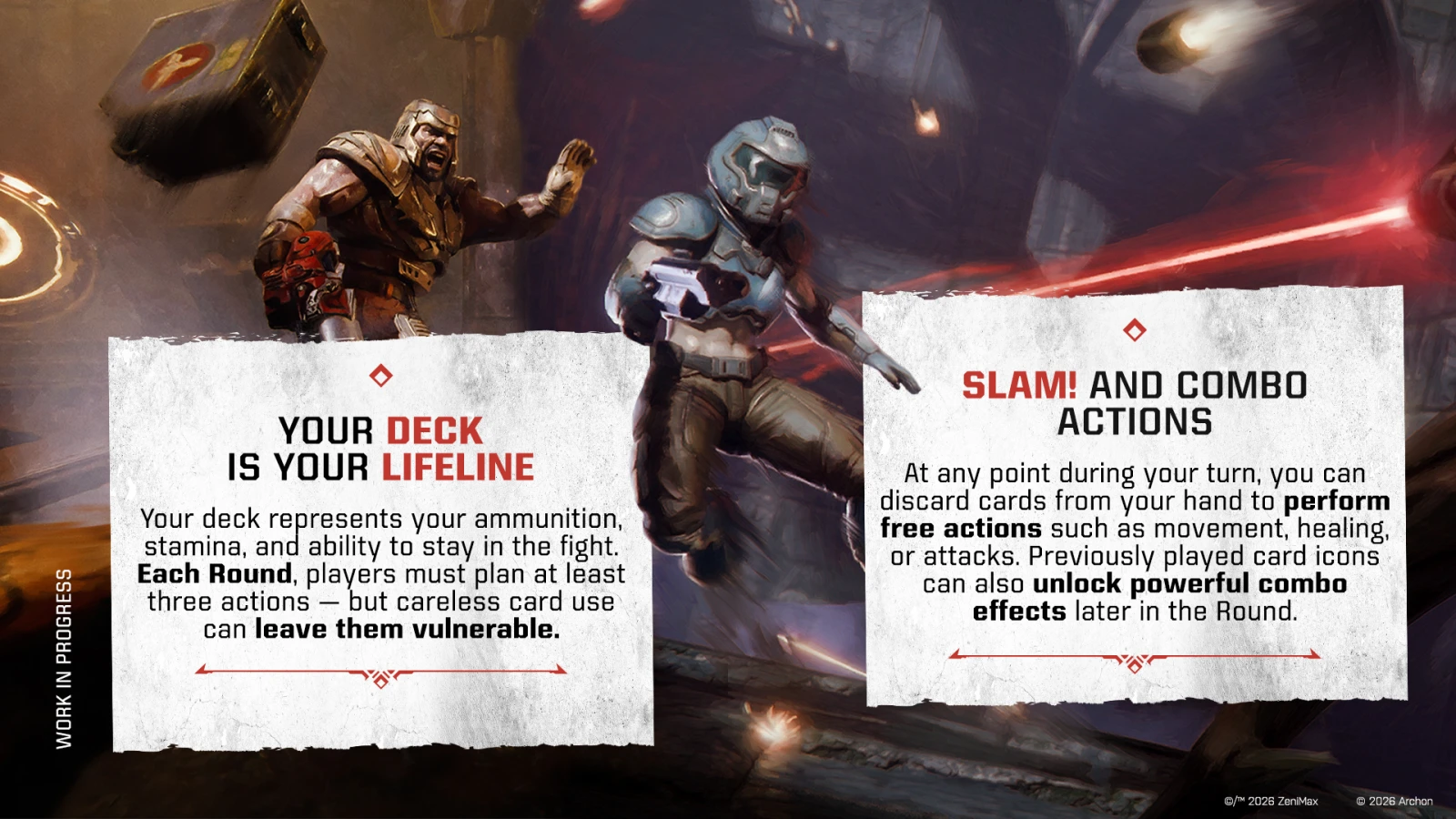
Your deck is your lifeline
In Quake: The Board Game, movement is survival, and your deck represents your ammunition, stamina, and connection to the server all at once. At the start of each Round, players don't wait for their turn. Instead, everyone simultaneously plans all of their upcoming actions by assigning Action Cards to slots on their Player Boards. The rule is simple: every player must plan at least three turns each Round. How do you stay alive and remain in the game? You need to maintain a murderous pace. Hunt down powerful Power-ups scattered across the map and keep fragging everything that stands in your way. Defeated monsters and collected loot reward you with new opportunities to keep the carnage going.
Want to sit in a corner? Stop shooting? The lag will kill you. Always keep moving.
Once your actions are planned, you resolve them one by one. However, the situation in the Arena is rarely predictable. That's where the Slam! mechanic comes in. At any point during your turn, you may discard cards directly from your hand (Slam) to perform free actions such as additional movement, healing, or a quick attack. Even better, icons from cards you've already played act as Combo Requirements. These allow you to unlock devastating effects and trigger more powerful attacks on the cards you resolve later in the Round. Let's see what happens when you get a little too excited.
Example: A furious Fiend suddenly leaps at you. In a panic, you Slam two cards from your hand to perform free dodge actions. You discard another card to blast it with your Shotgun and somehow survive the encounter. Then you realize... Your hand is empty. The next Planning Phase begins, but you don't have enough cards left to place the required three actions. If that happens, the game punishes you brutally.
In Deathmatch (PvP), you gain the Lagging status. You must discard all remaining cards, completely lose your first turn, stand helplessly in front of your enemies, and worst of all, you lose 1 Victory Point. In Co-op, things get even worse. You become Fragged and are disconnected from the server. Your Hero is eliminated for the remainder of the Level, leaving you to watch as the rest of your team desperately fights for survival without you. They'll probably thank you later.
Distance matters and the Arena isn't flat
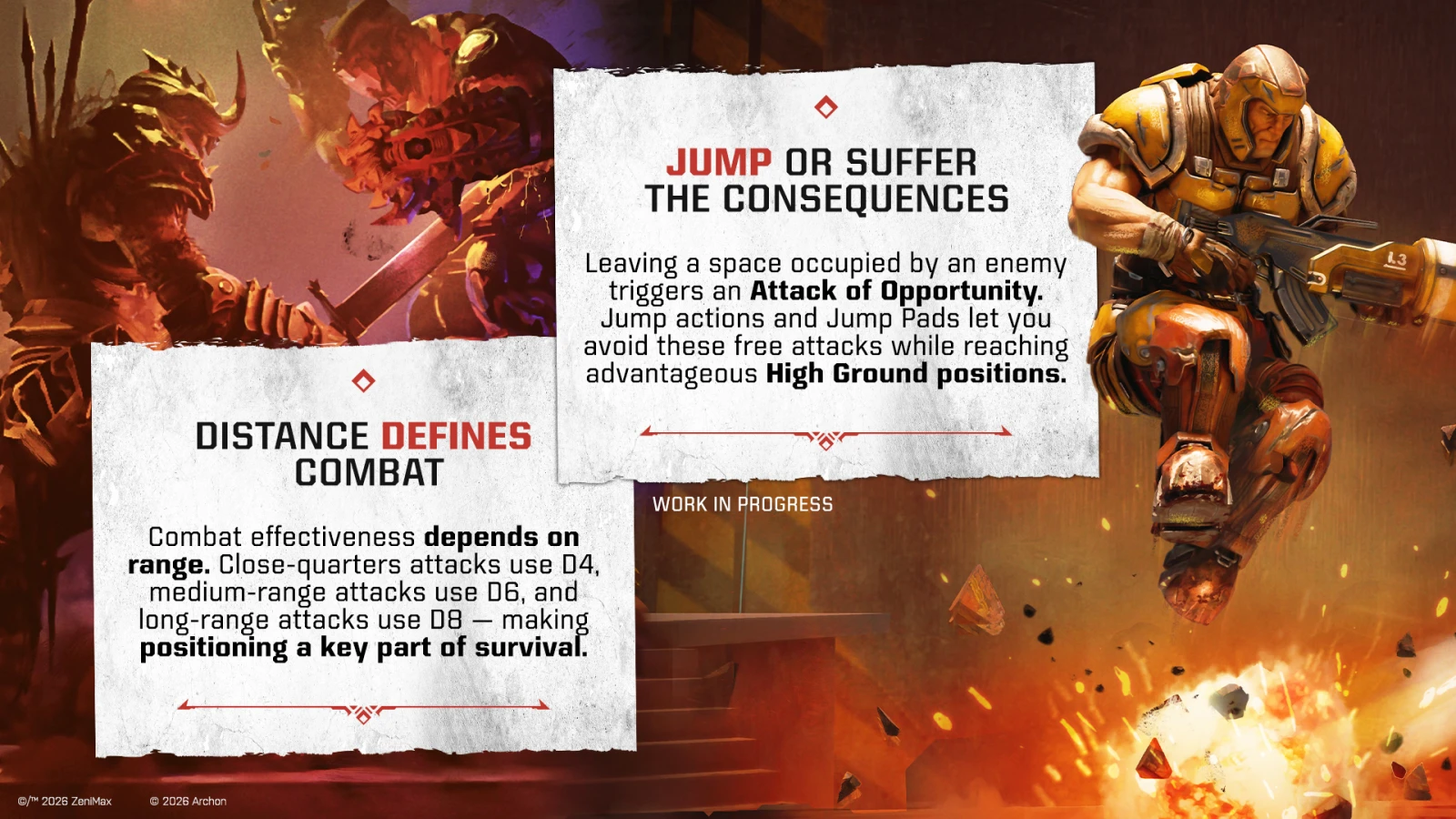
In Quake: The Board Game, every shot depends on correctly judging the distance to your target. Combat uses three different types of dice: D4 for brutal close-quarters combat, D6 for medium-range engagements, and a D8 for long-range attacks. When an enemy is breathing down your neck, the base Accuracy to the target is 2, and increases by 1 for every space between you and the target. The farther away your enemy is, the better the weapon you'll need. Their movement algorithm is simple but deadly. And forget flat game boards. Our Arena features fully three-dimensional terrain using High Ground and Low Ground mechanics. Occupying elevated positions changes your Line of Sight and provides additional protection against attacks from below.
Positioning is everything. Simply leaving a space occupied by an enemy automatically provokes a free Attack of Opportunity. You'll get stabbed, clawed, or blasted before you even have a chance to escape. How do you avoid it? Use Jump actions or launch yourself with classic Jump Pads. Jumping allows you to completely ignore Attacks of Opportunity and reach elevated terrain without punishment.
Example: You charge into a room and end up face-to-face with a massive Tank. You unload a barrage of fire into the armored beast, but it's still standing and ready to turn you into scrap metal. Walking away would trigger a free Attack of Opportunity. Instead, you Slam a card containing a Run symbol and perform a free Jump. You launch yourself into the air, ignore the Tank's attack, and land safely on nearby High Ground. From there, you gain a perfect tactical position and suddenly the monster is the one trapped in your sights.
Run smart. Jump high. Never turn your back on a monster.
Who controls the Hordes?
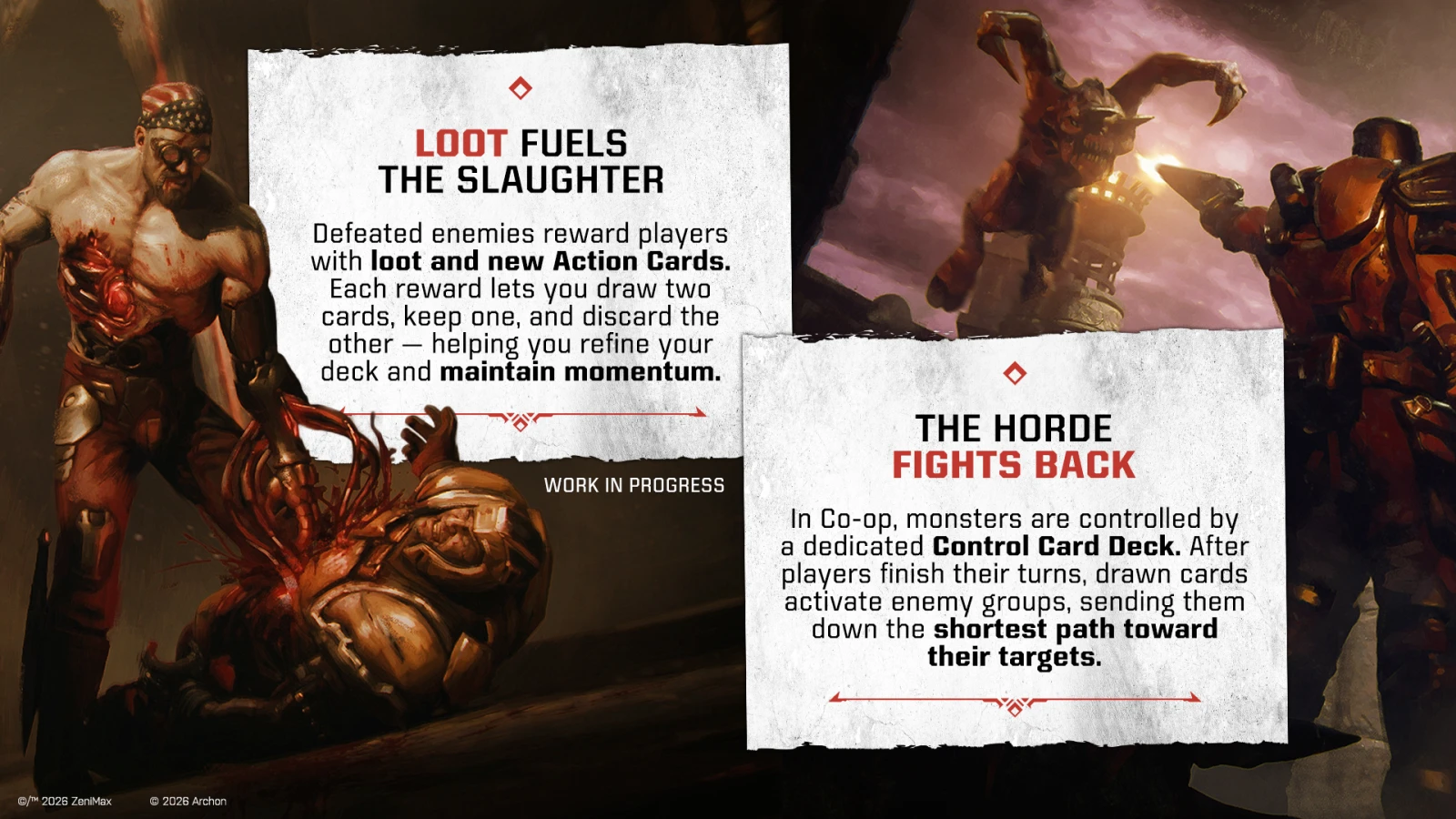
Think enemies politely wait for their turn in Co-op? Think again. The monsters are driven by a ruthless Control Card Deck. Once players finish their turn full of frantic fragging and tactical maneuvering, the server calls in reinforcements. A Control Card is drawn, activating specific groups of monsters on the map. Wondering if they're easy to outsmart? Their movement algorithm is simple and deadly. A monster always takes the shortest possible path toward its target. If multiple routes are equally effective, the Arena follows a strict rule: the monster moves toward the map tile with the lowest ID number. Simple. Efficient. Terrifying.
Loot, rewards, and bigger guns
Once you've reduced a monster to dust, it's time to collect your reward. Grab the dice and see what you've found. Loot is divided into three Tiers. The bigger and nastier the monster, the better equipment it carries. The reward system reinforces the game's aggressive tempo. Whenever you gain loot, you always draw two Action Cards, keep the one that best fits your preferred style of destruction, and discard the other. This allows you to constantly expand and refine your arsenal while ensuring you never run out of ammunition for the battles ahead.
Enter the Arena
Are you ready to step through the Slipgate and storm the Arena? Make sure to follow our campaign, because this is only the warm-up. We've barely begun revealing the secrets hidden within the blood-soaked corridors of the Arena. Let us know what you think about the mechanics we’ve shown today in the comments on our Gamefound page and social media channels. We're always ready for your feedback, and we can't wait to hear your thoughts!